If you are planning to visit Bali in 2027, looking at the island’s cultural calendar can tell you much more than when a festival happens. It provides a glimpse into how Balinese Hindu traditions shape everyday life through ceremony, community, spirituality, and a deep connection with nature.
Unlike the Gregorian calendar, many Balinese festivals and ceremonies follow traditional calendar systems. This is why celebrations such as Galungan, Kuningan, Saraswati, and Tumpek fall on different Gregorian dates each year.
Understanding these cycles can offer a deeper perspective on Bali’s culture, from the meaning of purification and gratitude to the importance of knowledge, harmony, and community.
Understanding the Balinese Calendar
Bali’s traditional calendar is different from the Gregorian calendar. Two systems are particularly important for understanding the island’s religious and cultural rhythm: the Pawukon calendar and the Saka calendar.
The 210-Day Pawukon Calendar
The Pawukon calendar follows a 210-day cycle rather than a 365-day year. It is divided into 30 wuku, each lasting seven days. Many important Balinese ceremonies follow this cycle. Galungan and Kuningan, for example, occur every 210 days. Other sacred days, including Saraswati, Pagerwesi, and Tumpek ceremonies, also follow the Pawukon system.
This explains why a ceremony can appear to “move” through the Gregorian calendar from one year to another. The calendar also includes several overlapping cycles of days, including the seven-day week and shorter five- and three-day cycles. Their combinations help determine sacred days and ceremonial occasions. The result is a calendar that is less about simply counting days and more about recognizing recurring spiritual and communal rhythms.
The Saka Lunar Calendar
The Saka calendar is a lunisolar system and is particularly important for determining Nyepi, the Balinese New Year. Because it follows lunar cycles, Nyepi falls on a different Gregorian date each year. Together, the Pawukon and Saka calendars create a cultural calendar in which sacred occasions can happen throughout the year.
Major Balinese Festivals and Ceremonies in 2027
While there are ceremonies happening across Bali throughout the year, here are some major celebrations in Bali on 2027.
Galungan 2027 – January 13 and August 11
Galungan 2027 falls on January 13 and August 11. It is one of the most important celebrations in the Bali cultural calendar, marking the victory of dharma over adharma, commonly understood as the triumph of good over evil. Galungan is traditionally associated with the return of ancestral spirits to the earthly realm to visit their families. Families prepare offerings, pray at temples, and gather together during the ceremonial period.
One of the most recognizable symbols of Galungan in Bali is the penjor, a tall, curved bamboo pole decorated with coconut leaves, flowers, fruits, and other offerings. During Galungan, penjors line streets and entrances across villages, becoming a visible expression of devotion.
The celebration continues for 10 days and concludes with Kuningan. Beyond its religious rituals, Galungan highlights the importance of dharma, family, ancestral relationships, and community responsibility in Balinese life.
Kuningan 2027 – January 23 and August 21
Kuningan 2027 falls on January 23 and August 21, ten days after each Galungan celebration. Kuningan marks the closing of the Galungan period. In Balinese Hindu tradition, ancestral spirits return to the spiritual realm after visiting their families, and prayers and offerings are made as part of this farewell. The day emphasizes remembrance, gratitude, family, and spiritual connection, showing how relationships with ancestors remain an important part of Balinese religious life.
Read also: Galungan & Kuningan Celebration: Bali’s Major Cultural Festivals Explained
Melasti 2027 – Before Nyepi
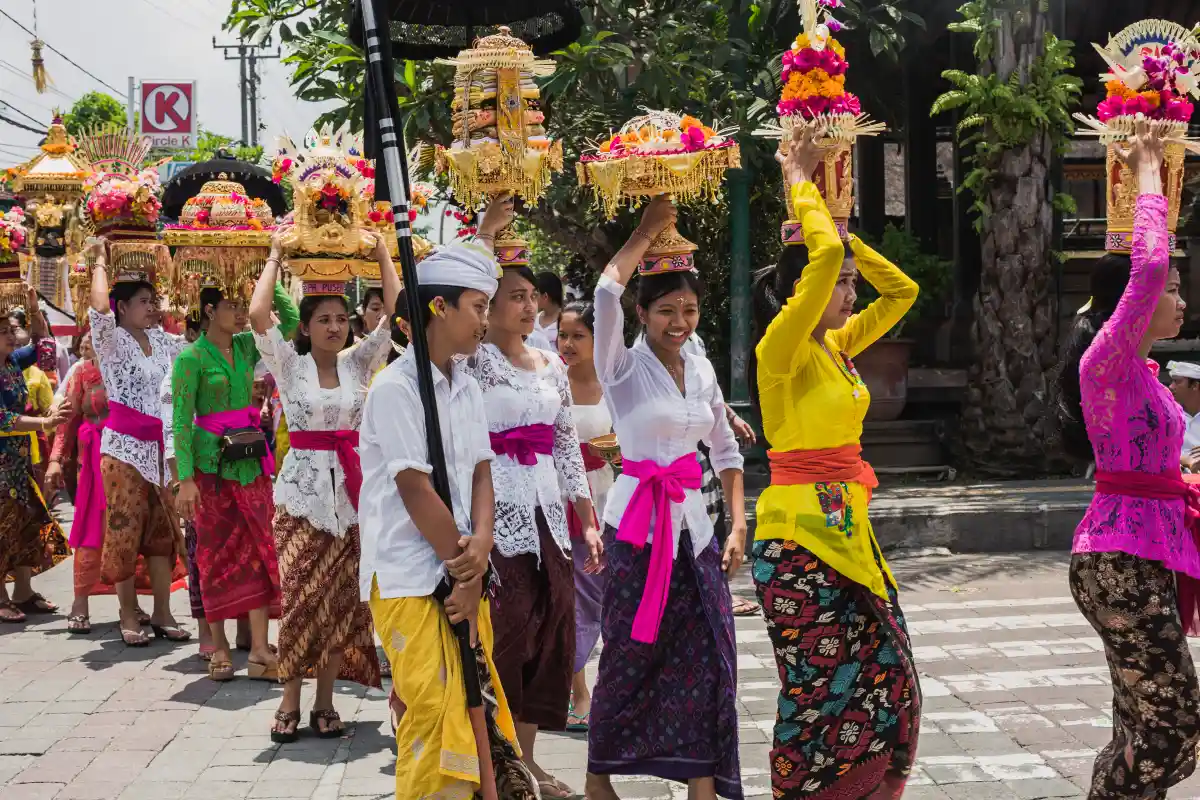
Melasti is a purification ceremony traditionally held in the days leading up to Nyepi. Sacred objects from temples are carried in procession toward the sea, rivers, lakes, or other sources of water. Water has an important symbolic role in the ceremony, representing purification and cleansing before the beginning of a new year.
Melasti is also deeply communal. Families and local communities come together to prepare offerings, carry sacred objects, pray, and participate in purification rituals. The exact date of Melasti can vary between communities, so local temple and village schedules are important when determining the timing of a particular procession.
Read also: Melasti Ceremony in Bali: A Purification Ritual and a Reminder to Protect Water
Nyepi 2027 – March 8
Nyepi 2027 is expected to fall on March 8. Known as the Balinese Day of Silence, Nyepi marks the Balinese New Year according to the Saka calendar. It is one of the most distinctive and significant dates in the Bali cultural calendar. For approximately 24 hours, Bali enters a period of silence and reflection. Roads become quiet, businesses close, transportation stops, and Ngurah Rai International Airport suspends operations. The observance traditionally includes restrictions on travel, work, entertainment, and unnecessary lights or fire.
The silence of Nyepi follows the dramatic Ogoh-Ogoh processions held the previous evening. Communities carry large handcrafted effigies through the streets as part of rituals associated with purification and the removal of negative influences.
The following day, Ngembak Geni, marks the return to everyday activities and a time for reconnecting with family and community. Nyepi demonstrates the importance of purification, self-reflection, balance, and renewal within Balinese Hindu practice.
Read also: All About Nyepi in Bali: The Sacred Day of Silence
Saraswati Day and Pagerwesi
The Balinese calendar also includes sacred days dedicated to knowledge, wisdom, and spiritual strength.
Saraswati Day – May 29
Saraswati Day is dedicated to knowledge, learning, wisdom, literature, and the arts. Books, manuscripts, and learning materials are treated with special respect, while offerings are made as an expression of gratitude for knowledge.
Saraswati reflects a broader Balinese understanding of knowledge as something to respect, cultivate, and use responsibly. The day connects education, spirituality, creativity, and personal growth within Balinese culture.
Read also: Saraswati Day in Bali: Celebrating Knowledge Learning and Cultural Continuity
Pagerwesi – June 2
Pagerwesi is associated with spiritual strength, protection, and inner resilience. The name combines pager, meaning fence or barrier, with wesi, meaning iron, conveying the symbolism of a strong spiritual protection.
Offerings and prayers are made as part of the observance. Pagerwesi can also be understood alongside Saraswati as part of a sequence of sacred days emphasizing knowledge, spiritual strength, and personal development.
Tumpek Ceremonies in 2027
Not every important Balinese ceremony takes the form of a large festival. The Tumpek ceremonies show how religious traditions are closely connected to everyday relationships with animals, plants, tools, art, and other aspects of life.
Tumpek days follow the 210-day Pawukon calendar and occur every 35 days. Each ceremony has its own focus and symbolism. Current 2027 calendar references identify the following dates.
Tumpek Kandang – April 3
Tumpek Kandang is associated with animals and expresses gratitude for their role in human life. Offerings and prayers are traditionally connected with domesticated animals and livestock. The ceremony reflects the importance of maintaining harmony between people, animals, and the natural environment.
Tumpek Wayang – May 8
Tumpek Wayang is associated with wayang, the traditional art of shadow puppetry, as well as performance and storytelling. The ceremony highlights the relationship between art, cultural expression, and spirituality, reflecting the important role traditional performance plays in Balinese life.
Tumpek Landep – June 12
Tumpek Landep falls on June 12.The ceremony is traditionally associated with metal objects and tools. Its meaning also extends beyond physical objects, with “sharpness” understood symbolically in relation to clarity of thought, intelligence, and discernment.
Tumpek Uduh / Tumpek Wariga – July 17
Tumpek Uduh, also known as Tumpek Wariga. This ceremony is dedicated to trees, plants, and the natural environment. Offerings express gratitude for nature and the resources that sustain life. Tumpek Uduh reflects the Balinese understanding that human wellbeing is connected to maintaining a respectful and balanced relationship with the natural world.
Tumpek Krulut – February 27 and September 25
Tumpek Krulut is associated with musical instruments, masks, and other artistic elements used in ceremonial and cultural expression. The ceremony highlights the importance of music, creativity, beauty, and harmony within Balinese cultural life.
Read also: Tumpek Landep & Tumpek Kandang: Balinese Ceremonies of Stewardship Tools Technology and Animals
Bali Temple Festivals: Understanding Odalan
Beyond the major Balinese festivals listed on a general cultural calendar, thousands of temple celebrations take place across Bali throughout the year. These celebrations are known as odalan, or temple anniversaries. An odalan commemorates the anniversary of the consecration of a temple or sacred shrine and follows the Pawukon calendar. Because each temple has its own anniversary, there is no single date for all Bali temple festivals. One temple may hold its odalan in January, while another celebrates later in the year.
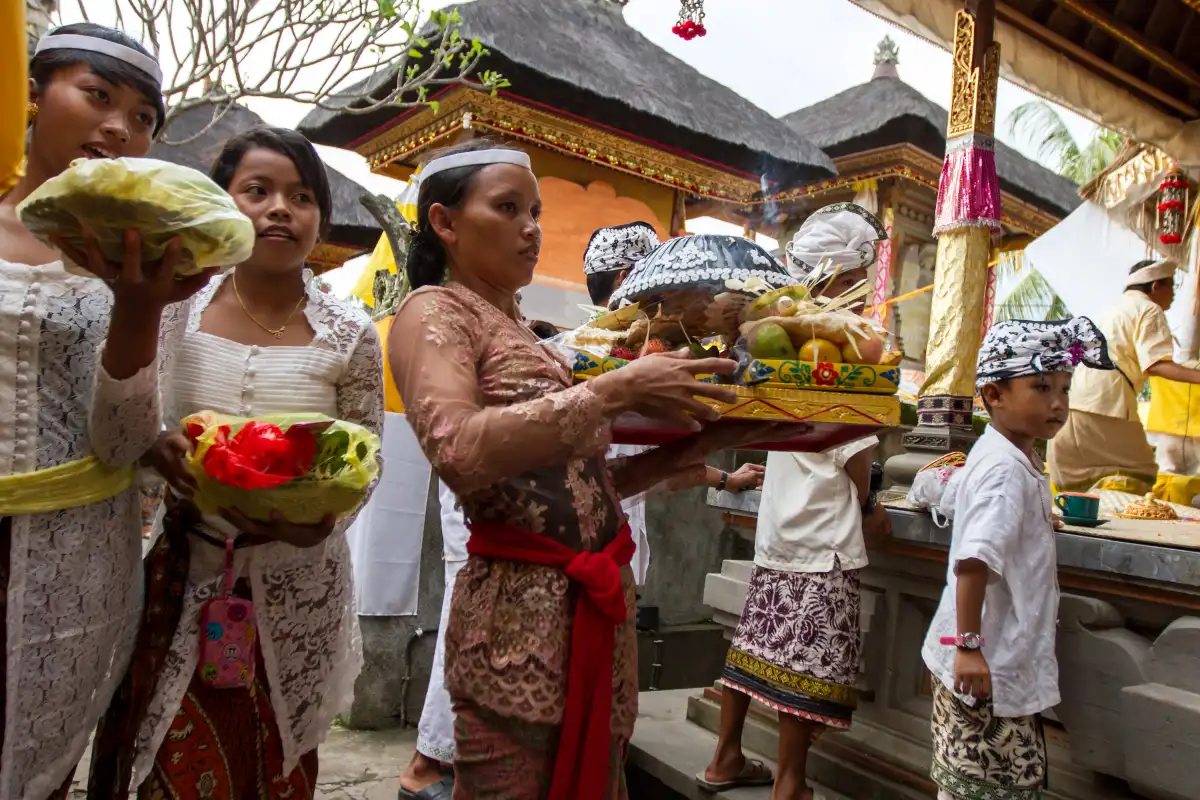
An odalan can include prayers, offerings, traditional music, dance, processions, and communal activities. The scale and duration depend on the temple and local traditions. Balinese religious life is not limited to the largest island-wide celebrations. Much of it happens within individual villages, families, and temple communities throughout the year.
Read also: Balinese Gods and Hindu Deities: Understanding Bali’s Spiritual Landscape
What Balinese Festivals Teach About Balinese Culture
The Bali cultural calendar 2027 is more than a collection of religious dates. Each Balinese festival and ceremony reflects values that continue to shape relationships with family, community, nature, knowledge, and the spiritual world. Understanding these values adds context to the rituals themselves and shows how Balinese ceremonies remain closely connected to everyday life, such as:
- Purification: Melasti and Nyepi emphasize cleansing, reflection, and renewal.
- Knowledge: Saraswati connects learning with wisdom, creativity, and personal growth.
- Protection: Pagerwesi highlights spiritual strength and resilience.
- Gratitude: Tumpek ceremonies express appreciation for animals, plants, tools, music, and art.
- Harmony: Ceremonies reinforce balance between people, nature, ancestors, and the spiritual world.
- Community: Families, neighbors, temple communities, and artists often work together to prepare and carry out ceremonies.
Together, these traditions show that Balinese festivals are not isolated events. They form an ongoing cultural rhythm connected to everyday life.
Respectful Ways to Observe Balinese Ceremonies
Balinese ceremonies are deeply connected to religious practice, family traditions, and community life. Here are some notes to observe Balinese ceremonies respectfully:
- Dress respectfully: Wear modest clothing and a sarong and sash when required at temples.
- Ask before taking photos: Be especially careful when photographing people during prayer.
- Respect ceremonial spaces: Do not enter restricted areas, cross processions, or move sacred objects.
- Give space during prayer: Keep your voice low and avoid unnecessary movement.
- Do not touch offerings: Avoid moving or stepping over canang sari and other offerings.
- Follow local guidance: Temple attendants and community members may have specific rules for each ceremony.
The key is to remember that a Balinese ceremony is a living religious tradition, not a cultural performance.
A Living Calendar of Balinese Culture
The Bali cultural calendar is more than a schedule of festival dates. It reflects a living cultural rhythm in which ceremony, community, family, nature, knowledge, and spirituality are closely connected.
Each Balinese festival and ceremony carries its own meaning. These traditions form an ongoing cycle rather than a series of separate celebrations. They provide regular moments for communities to pray, reflect, express gratitude, maintain relationships, and reaffirm shared values.
This is what makes the Balinese cultural calendar meaningful. Understanding when a ceremony takes place is only the beginning; understanding why it matters offers a deeper perspective on Balinese culture and the values that continue to shape everyday life in Bali.
Experience Bali Beyond the Calendar
The Bali cultural calendar is a starting point for understanding how ceremony, community, spirituality, and tradition shape everyday life in Bali. To go deeper, experiencing these traditions within their local context can make the learning much more meaningful.
Through Bali Institute’s cultural and community-based programs, participants can learn directly from local communities, explore Balinese traditions, and connect classroom learning with real experiences across the island. Explore Bali Institute’s programs and discover Bali through the people, traditions, and communities that bring its culture to life.