A large banyan tree can be one of the most recognizable features of a Balinese village. Its wide canopy, hanging roots, and age make it stand out among temples, homes, roads, rice fields, and community spaces.
Some banyan trees also have cultural or spiritual significance. They may stand near a temple or shrine, form part of a village space, or be connected to local stories and beliefs. However, not every banyan tree in Bali has the same meaning. Its significance depends on its location, history, and relationship with the surrounding community.
Looking at these differences offers a useful way to understand Balinese Hinduism, village life, ecology, and Bali’s cultural landscape.
A Banyan Tree Is More Than a Tree
A banyan is a large tropical tree known for its broad canopy and distinctive aerial roots, which grow down from its branches and can eventually form additional trunks. Mature banyans are a familiar feature of many Balinese landscapes.
The tree itself does not automatically make a place sacred. Some banyans have religious or cultural significance, while others are simply valued for their shade, size, beauty, or environmental benefits. Understanding a particular tree therefore requires looking at its local context and how people interact with it.
Read also: Tri Hita Karana
Sacred Banyan Trees and Balinese Hinduism
There is no single rule that makes every banyan tree sacred in Balinese Hinduism. A particular tree can become culturally significant because of its connection to a temple, shrine, ceremony, local belief, or tradition.
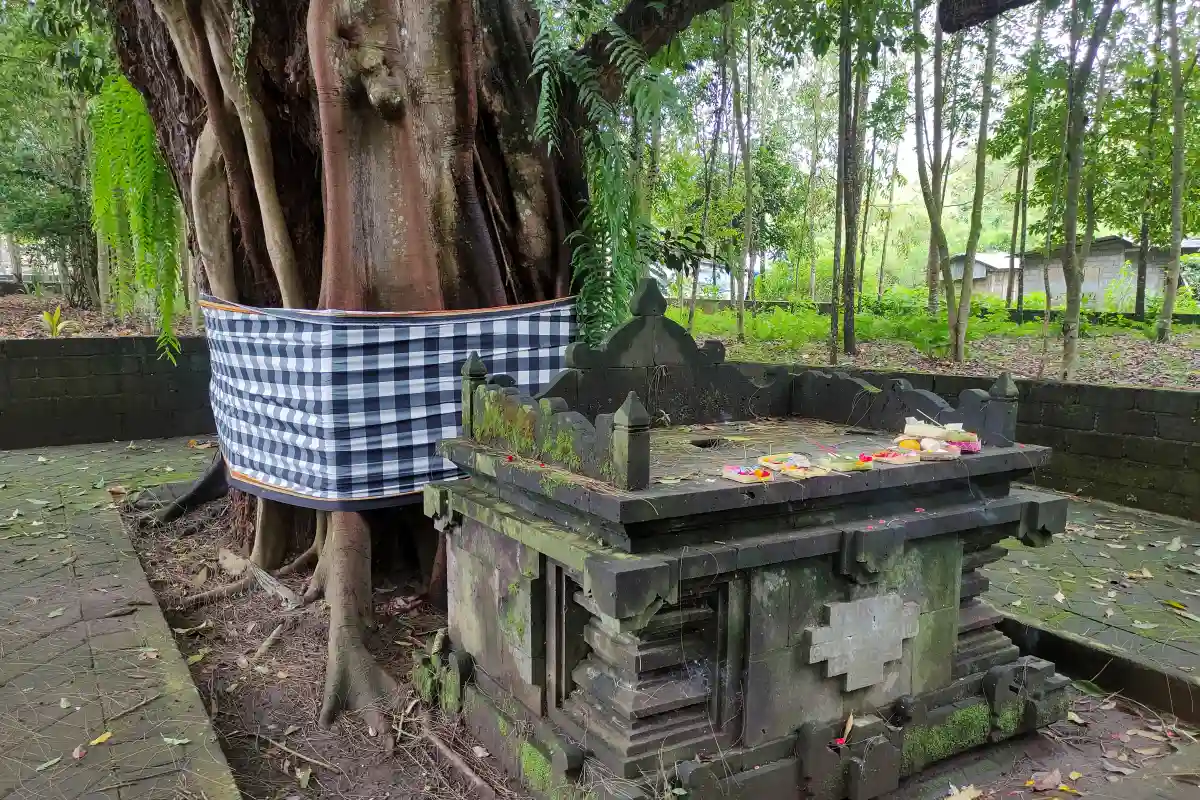
Trees Near Temples and Shrines
A banyan growing near a temple or shrine can form part of the surrounding sacred space. Offerings may be placed nearby, and the area may be maintained as part of the religious environment. Its significance comes from this cultural context rather than simply from being a large or old tree.
Trees in Village Spaces
Banyans can also have an important social role in Balinese villages. Their shade can create a comfortable gathering space, while a large mature tree can become a familiar village landmark. This shows how one tree can have several roles at once, connecting religious, social, and environmental aspects of community life.
Read also: Balinese Hinduism
What Does a Banyan Tree Symbolize in Bali?
The Bali banyan tree meaning varies between places and communities. A particular tree may be associated with spirituality, protection, ancestry, sacred space, or local stories. Its size and long lifespan can also make it an important landmark that carries memories and traditions across generations.
The important distinction is that these meanings are not automatically attached to every banyan tree. A tree becomes culturally significant through its relationship with the people and place around it.
The Environmental Value of Large Banyan Trees
A mature banyan is also an important part of the local environment. Its large size and complex structure provide benefits beyond the space directly underneath the tree.
Shade and Local Climate
A broad canopy blocks direct sunlight and creates a cooler, shaded area beneath the tree. This can make open village and community spaces more comfortable.
Habitat for Wildlife
The branches, aerial roots, bark, flowers, and fruit provide food and shelter for birds, insects, and other organisms. A mature banyan can therefore support a variety of life within and around the tree.
Why Mature Trees Matter
Banyans take many years to develop their large canopies and complex root structures. Protecting mature trees preserves environmental features that cannot be quickly replaced by planting new ones.
Read also: Bali Animal Conservation
When Culture Helps Protect Nature
Cultural values can influence how communities care for natural features. When a banyan is connected to a temple, shrine, village tradition, or sacred place, its cultural importance can encourage people to maintain the tree and the surrounding space.
This protection is not automatic. Development, land use, and other environmental pressures can still affect culturally important trees. However, cultural significance can give communities an additional reason to preserve them.
The same connection between culture and the environment can be seen on a much larger scale in Bali’s cultural landscape. UNESCO’s recognition of the subak system highlights the relationship between religious practices, community organization, agriculture, water management, and the natural environment. A sacred banyan provides a smaller, easier-to-observe example of this broader relationship.
Read also: Regenerative Tourism in Bali
A Sacred Tree as an Experiential Learning Exercise
A banyan tree can become a useful field-study subject for exploring culture, ecology, and local knowledge. Students can observe the tree and its surroundings before learning about the traditions connected to it.
Start With Observation
Look at the physical environment:
- Where is the tree located?
- How large is its canopy?
- Are aerial roots visible?
- What plants and animals are nearby?
- Is there a shrine or other structure?
- Are offerings present?
Learn From Local Perspectives
Students should speak with a local guide, community member, or knowledgeable resident rather than interpreting the tree entirely on their own. Useful questions include:
- Why is this tree important?
- Is it connected to a temple, shrine, or ceremony?
- Are there stories associated with it?
- Who takes care of the surrounding area?
Connect Culture and Ecology
The final step is to consider both sides together. How does the tree’s cultural role influence the way people care for it? What environmental functions does it provide? What could happen to its role if the surrounding area changed?
This approach can introduce students to ethnobotany, cultural ecology, belief systems, and conservation through one familiar feature of the Balinese landscape.
Sacred Trees and Responsible Visits
A sacred tree should be approached as part of a cultural space, not simply as a photo opportunity. Follow local instructions and avoid climbing trees, touching shrines, or disturbing offerings.
Keep the area clean and free from rubbish. Ask before photographing people, particularly during ceremonies, and follow any restrictions around temples or sacred areas. The most respectful approach is simple: observe first, ask when unsure, and leave the place as you found it.
Read also: Experiential Education in Bali
What a Banyan Tree Can Teach Us About Bali
A banyan tree offers a simple way to understand how nature, culture, and community life connect in Bali. Its location, the traditions surrounding it, and the way people care for it can reveal different layers of local life. A banyan near a shrine may have a religious role, while another tree along a village road may be valued mainly as a landmark or gathering space.
There is therefore no single explanation for every sacred banyan tree in Bali. Understanding the local context provides a more accurate picture of how Balinese communities relate to nature and the places they value. Through Bali Institute’s University Experiences, students can explore connections between culture, religion, environment, and community through field-based learning. Bali Institute’s Adult Learning Journeys also offer opportunities to engage more deeply with Bali’s cultural landscapes, local perspectives, and living traditions.